The book · James's chapter
Roadmap to Success
America’s Top Intellectual Minds Map Out Successful Business Strategies
James Carter — chapter “Be Legendary” — featured alongside Deepak Chopra and Dr. Ken Blanchard · Insight Publishing, 2012
The short version
Roadmap to Success is a collaborative book — interviews with successful leaders on how they reach the top and stay there. James Carter’s chapter, “Be Legendary,” is where the whole idea began. It’s free to read — and the rest of this page is what it grew into.
Where “Be Legendary” started
Years before the Flag Model™ or a single leadership offsite, James was invited into Roadmap to Success (Insight Publishing, 2012) — a collaborative volume where accomplished leaders each set down their own map, in the interview format the series is known for (with David Wright). James is featured on the cover alongside Deepak Chopra and Dr. Ken Blanchard. His chapter didn’t describe a tactic. It named a way of living, and gave it a phrase that stuck.
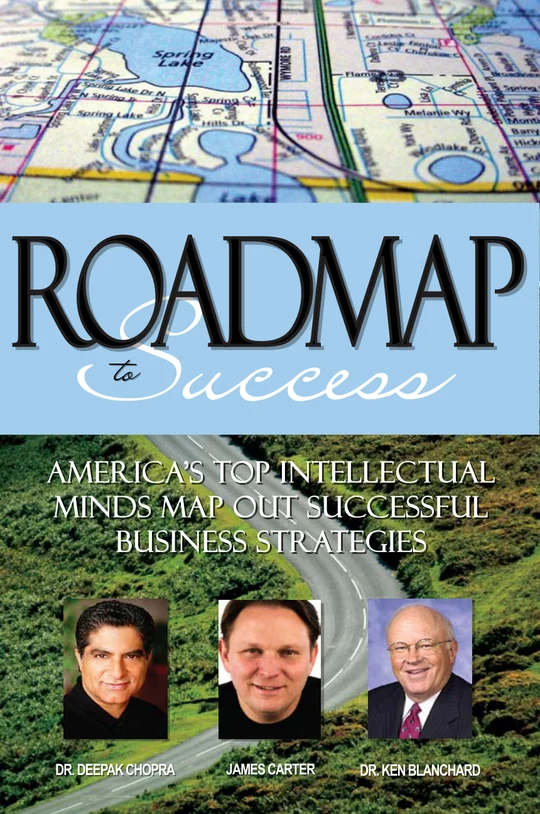 Chopra · Carter · Blanchard
 “Be Legendary is having the courage to take action based upon your core beliefs to make a positive difference in the world around you. Not about being better than anyone else. Not about glory or fame. It is our own personal evolution — the discovery and rediscovery of the very best of who we are, and who we can be.”
What it grew into
One idea. Two ways to live it.
The courage to act on your beliefs became a discipline — for one leader, and for a whole team. Pick the door that fits where you’re standing.
Read the original chapter
James Carter’s “Be Legendary” from Roadmap to Success — free, no email required.
Straight answers
What is Roadmap to Success?
Roadmap to Success (Insight Publishing, 2012; ISBN 978-1-60013-921-5) is a collaborative business book — "America's Top Intellectual Minds Map Out Successful Business Strategies" — in which accomplished leaders each contribute a chapter on how they reach and stay at the top. James Carter, founder of Be Legendary, is featured on the cover alongside Deepak Chopra and Dr. Ken Blanchard; his chapter is titled "Be Legendary."
Did James Carter write Roadmap to Success?
James co-authored it — he contributed the chapter "Be Legendary" and is one of the authors featured on the cover, alongside Deepak Chopra and Dr. Ken Blanchard. It is one of several collaborative works he has contributed to, together with Discover Your Inner Strength (co-authored alongside Stephen Covey, Ken Blanchard and Brian Tracy).
What is the "Be Legendary" chapter about?
It defines being legendary as "having the courage to take action based upon your core beliefs to make a positive difference in the world around you" — not fame or being better than anyone else, but your own personal evolution: the discovery and rediscovery of the very best of who you are, and who you can be. It is the seed of everything Be Legendary teaches today.
Can I download it for free?
Yes. James's chapter is free to read — download the PDF above. No form, no email required.
“James helped us turn seven groups of rivals into one leadership team. By the time US Holdings became Eagle Manufacturing Group and I moved from COO to CEO, we were no longer seven companies protecting our own territory — we were one company working toward the same outcome.”
Ronn Page · former CEO, Eagle Manufacturing Group

About the author
James Carter
Founder of Be Legendary and creator of the Flag Model™. Twenty-five years inside executive teams; co-author alongside Stephen Covey, Ken Blanchard, Deepak Chopra & Brian Tracy, and featured on CNN and in Business Insider. More about James →
See where your team breaks first.
A Calibration Call is 15 minutes — you leave with a concrete read on your team, whether or not we work together. It's a calibration, not a pitch.
Not ready to talk? Start free
Take the free Break-Point Self-Assessment
See which of the five components your team is most likely to lose first — in ~4 minutes. No email required to see your result.
Field notes, by email
Straight thinking on executive-team execution.
One short note, roughly monthly, on the disciplines that decide whether a leadership team executes. No fluff, no pitch. Unsubscribe anytime.