Executive team building
Executive team building that builds how your leadership team decides, disagrees, and executes.
Your executive team is the highest-leverage decision system in the company. This is a facilitated intervention engineered around how it actually operates under pressure — then reinforced so it holds. Not trust falls, not two days out of the office you’ll have forgotten by Monday.
It scales to the problem — from a single instrumented read to a sustained partnership. The format follows the problem — never the other way around.
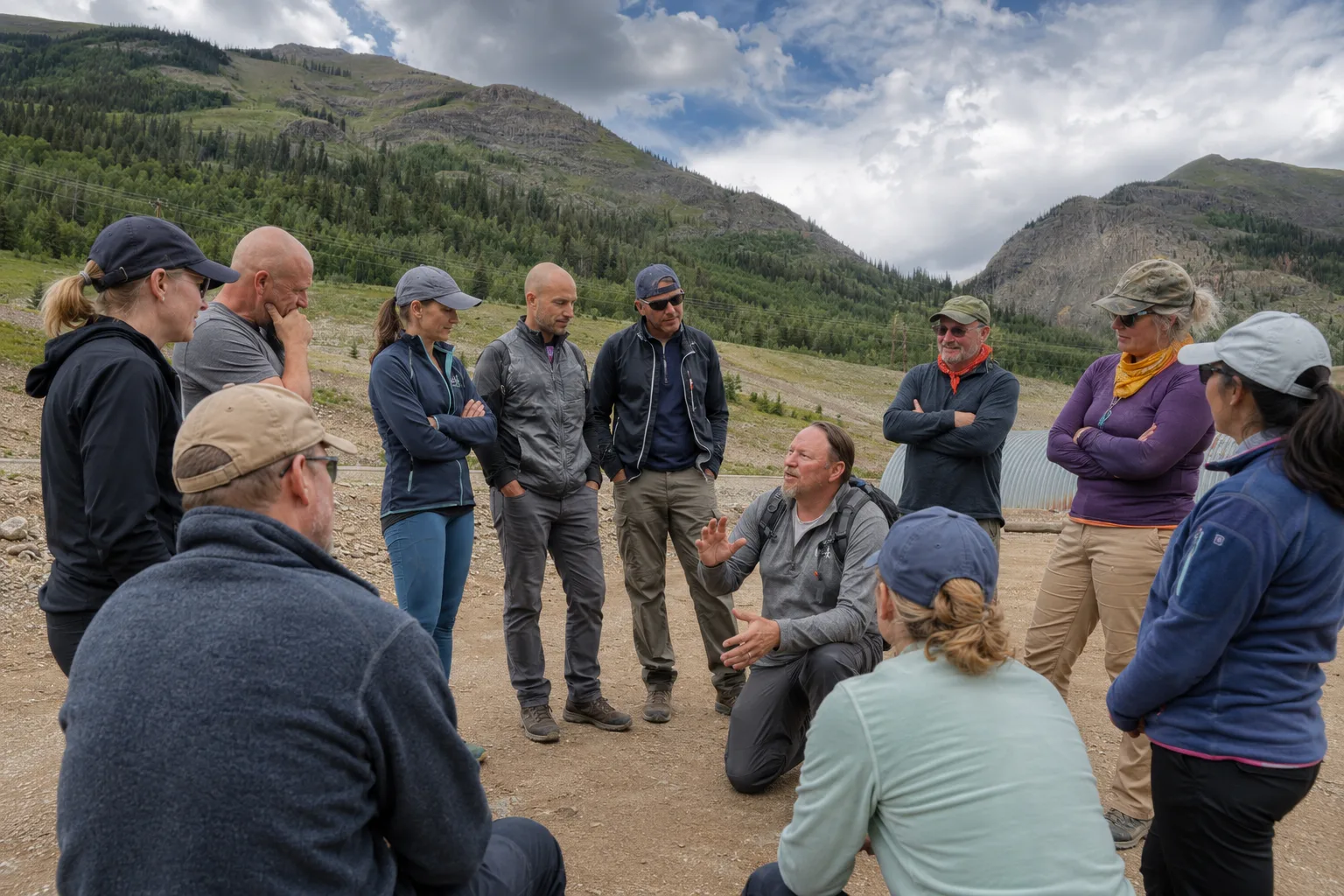
What is executive team building?
The deliberate work of turning capable functional leaders into a single decision-making unit — one that sets shared priorities, disagrees productively, and executes across boundaries. The research is clear about where the value is: not in the activity, but in what a team does with it — exposing how it really operates, then converting that into how it decides.
What we run
Built around your team’s real fault line — from a single read to a full partnership.
Before we design anything
We interview before we design.
We start with a calibration call, then talk with two or three people on the team. From that we state a hypothesis about where the team actually breaks — and build the day around that fault line, rather than pulling one off a shelf. That single step is the difference between this and what an events vendor sells you.
The instruments, lightest to deepest
Team LFS — the instrumented read A live behavioral simulation, about 90 minutes, that logs how your team actually decides under pressure — with individual and team reports and a FlagScore™ baseline you can measure against. Explore → The Executive Team Diagnostic — the outside read Over about three weeks: interviews with the CEO and each executive, a live leadership meeting observed, and an analysis of how the team decides, disagrees and follows through, with a cost estimate and a clear go or no-go. Explore → The Discipline Sprint — a focused 90-day rebuild When the fault line is clear: a focused 90-day push on the one discipline that broke, reinforced so the change survives contact with Monday. Explore → The Performance Partnership — when the rebuild is the relationship A sustained engagement that installs the Flag Model over time and tracks FlagScore™ quarter over quarter — a relationship, not a workshop. Explore →Want the experiential format — an engineered off-site day, an expedition, or a multi-day retreat? Those run as our sister brand, Legendary Retreats →
At a glance
Everything you need to build the comparison.
Group, duration, how it runs, lead time, and what’s included — for every engagement. Pricing is scoped to your team on the call; a generic range would only mislead.
| Format | Group size | Duration | Where it runs | Lead time | Included |
|---|---|---|---|---|---|
| Team LFS → | Up to 8 executives | ~90 minutes | At your offsite, or virtually on individual devices | Short — within weeks | The simulation, individual & team reports, a FlagScore baseline and debrief |
| Executive Team Diagnostic → | The executive team (CEO + reports) | About three weeks | Interviews plus one live leadership meeting observed — on-site or remote | A few weeks to start | CEO and executive interviews, a live meeting observed, a written analysis with a cost estimate and a clear go / no-go |
| Discipline Sprint → | The executive team | ~90 days | Embedded in your existing operating rhythm | Weeks to start | A focused rebuild of the one discipline that broke, with measured behavior change across the sprint |
| Performance Partnership → | The executive team | 12 months | Ongoing, embedded in how the team works | Planned around your calendar | The full Flag Model installed over time, FlagScore tracked quarter over quarter, reinforced so it holds |
Planning this on behalf of an executive? Here’s exactly what to bring back →
Searching for executive team building activities, exercises or ideas?
Call them executive team building activities or team building activities for executives — the same truth holds either way. The activity is the least important variable — a rock climb, a day on the water, an off-road day or a strategy session can each transform a team or waste a day. What decides which is whether it’s engineered around a real fault line and converted into how the team decides afterward. We don’t sell activities; we use them.
Looking for the ongoing program rather than a single intervention? See executive team development → — the evidence-based process this fits inside.
What you just looked at, and why it works
What separates a day that works from a day away.
Changes nothing
- ×Entertainment presented as development
- ×Personality quizzes and generic labels
- ×Forced vulnerability and forced socializing
- ×A physical challenge unrelated to the team’s work
- ×A motivational speech with no behavior practice
- ×An activity followed by no application on Monday
- ×A retreat that carefully avoids the team’s real conflict
- דDid everyone have fun?” as the only measure
Changes the team
- ✓A defined business problem worth the executives’ time
- ✓Genuine interdependence — they need each other to succeed
- ✓Someone qualified observing how the team really operates
- ✓A structured debrief: what happened, why, where it shows up at work
- ✓Translation into decision rights, norms and priorities
- ✓Follow-through weeks later, to see if it survived
- ✓Measured on behavior and business outcomes, not enjoyment
The single most reliable finding in this field isn’t about the activity at all. Across 46 studies, structured debriefs — performing, getting honest evidence about how you performed, then converting it into changed behavior — improved effectiveness by roughly 20–25%, in real and simulated settings alike.1 The activity just creates something worth debriefing.
And when researchers compared training methods across 51 controlled studies, active practice and simulation moved teamwork and performance; lecture-style sessions barely registered.2 A 2018 review in American Psychologist put it plainly: different team problems require different interventions — which is exactly why we interview before we design.
1 Tannenbaum & Cerasoli (2013), Human Factors — debrief meta-analysis (d = 0.67). 2 McEwan et al. (2017), PLOS ONE — meta-analysis of 51 controlled teamwork interventions.
Why the executive team specifically
It isn’t a morale activity. It’s an intervention.
What caps most executive teams isn’t individual talent — every seat is filled by someone excellent in their function. It’s the interaction failures: ego, competing priorities and unspoken tension at the top; conflict that gets suppressed in the room and litigated afterward; agreement that isn’t real.
McKinsey’s assessment of top teams scored their collective health at just 44 out of 100 — and the weakest areas were all interaction capabilities: conflict management, feedback, psychological safety and innovative thinking. You don’t hire your way out of those. They’re built and practiced by the team, together.
Source: McKinsey, “Cracking the code of team effectiveness.”
44/100
Collective health of top executive teams, self-assessed. The lowest-scoring capabilities are all things a team can only build together.
The one team whose performance multiplies.
A frontline team’s mistakes are contained. An executive team’s are not. Every decision it makes — or delays, or quietly reopens — sets the terms for everyone below. The return on getting it right is not additive. It compounds.
≈ 2×
Aligned, effective top teams were roughly twice as likely to post above-median financial performance in McKinsey’s research — an association, not a guarantee, but a telling one.
The template
When executives disagree privately and signal different priorities publicly, the whole company learns to escalate instead of resolve. The executive team is the behavior the rest of the org copies.
Every hire
Each new appointment silently rewrites decision rights, alliances and trust. An org chart assigns authority. It does not create a functioning team — which is why cohesion can never be assumed.
How you’ll know it worked
We don’t measure whether people enjoyed it.
In the room
- ✓Shared priorities named out loud
- ✓Decision rights assigned
- ✓Real conflicts surfaced, not managed around
- ✓Commitments documented
In 30–90 days
- ✓Decision-cycle time
- ✓How often decisions get reopened
- ✓Commitment-completion rate
- ✓Cross-functional escalations, and how fast bad news travels
In the business
- ✓The specific outcome we started from
- ✓Integration or transformation milestones
- ✓Execution against the year’s priorities
- ✓Confidence in senior leadership
The behaviors above aren’t arbitrary — they map to the four disciplines of the Flag Model, the framework underneath this work, and we baseline them with a FlagScore so “better” isn’t a feeling. Causation inside a live company is never clean. What we hold ourselves to is a documented chain: intervention → changed executive behavior → changed operating process → measurable business effect. If we can’t draw that line, we don’t claim the result.
Proof
209%
Measured lift on the team’s self-selected mindset behaviors — Champion Iron executive retreat, AlUla, Saudi Arabia.
One team. A shift you can put a number on.
We ran an executive retreat for Champion Iron in AlUla, Saudi Arabia. Each leader chose the specific behaviors they wanted to change — the personal markers of a more positive mindset — and against that baseline the team measured a 209% improvement. Their own conclusion after the retreat, the activities and the hard conversations: that mindset would reshape how they approach the challenges ahead, and how they treat one another.
And it isn't one team
The pattern holds across the work.
$1.2B
revenue, up from $350M — seven rival firms unified into one
268%
behavioral gain in 30 days — two warring camps, one team
209%
mindset lift — Champion Iron executive retreat, AlUla
178%
teaming gain in 30 days — five poached all-stars, one team
Real engagements across a decade of retreats, immersions and partnerships. See the case studies →
And it’s not new. The press has covered this work since 2012 — you don’t get written up for something extraordinary until you’ve done it enough times to be great at it.
Straight answers
Executive team building, answered plainly.
What is executive team building?
Executive team building is the deliberate work of turning a group of individually capable functional leaders into a single decision-making unit — one that sets shared priorities above functional ones, disagrees productively, and executes across boundaries. Done seriously, it is an intervention aimed at the interaction failures that constrain senior teams, not a morale activity. The evidence is blunt about where the value sits: not in the activity, but in exposing how the team really operates and converting that into changes in how it decides and follows through.
Do executive team building activities actually work?
An activity on its own does almost nothing. Across 51 controlled studies, active practice and simulation improved teamwork while lecture-style sessions barely moved it — and the single most reliable finding in the field is that structured debriefs improve performance by roughly 20–25%. The activity is only worth its cost when it is engineered around a real problem, observed by someone who knows what they are watching, debriefed honestly, and translated into how the team decides afterward. That design is the intervention; the activity is just the laboratory.
What is the difference between executive team building and a team offsite or retreat?
They are formats, not different things. An offsite is a block of time away from operations; a retreat is a facilitated version of it. Executive team building is what you do with that time. A retreat with no honest conflict and no follow-through is an offsite with better catering. The question is never “where do we go?” — it is “what interaction failure are we here to fix, and how will we know it changed?”
Why does senior-team building need to be different from ordinary team building?
Because the failures are different. Executives rarely lack energy or camaraderie; they suffer from suppressed conflict, false agreement, unclear decision rights, and functional advocacy dressed up as strategy. Generic bonding does not touch those. And the stakes are multiplicative — the executive team’s behavior becomes the template the rest of the company copies. Building it is the highest-leverage move available, which is exactly why it should not be handed to an events vendor.
Is executive team building the same as senior management or senior leadership team building?
Yes — "executive team building," "senior leadership team building" and "senior management team building" all describe the same work: developing the small group at the top of the company into one decision-making unit. Whatever you call it, the target is the same set of failures — suppressed conflict, false agreement, unclear decision rights, and functional advocacy dressed up as strategy — and the same standard applies: it should be a facilitated intervention engineered around your team’s real fault line and reinforced afterward, not a bonding event. When you compare providers, that distinction — intervention versus event — is the line that matters most for a senior team.
How do you measure whether it worked?
Not by whether people enjoyed it. In the room: shared priorities named, decision rights assigned, real conflicts surfaced, commitments documented. Over 30–90 days: decision-cycle time, how often decisions get reopened, commitment-completion rate, cross-functional escalations, and how fast bad news travels. Then the specific business outcome we started from. Causation in a live company is never clean; what we hold ourselves to is a documented chain — intervention, to changed behavior, to changed process, to measurable result.
We just need executive team building ideas or exercises. Can you help?
Yes — but we will start by talking you out of choosing the exercise first. Tell us the problem (slow decisions, silo conflict, a post-acquisition team, a new C-suite that has never actually functioned together) and the right format follows. Book a Calibration Call and you will leave with a real read on where your team breaks first, whether or not we work together.
Are you executive team building consultants?
In the sense that we advise senior teams, yes — but "consultant" undersells what happens. Most executive team building consultants deliver an event or a report and leave; we run a facilitated intervention engineered around your team’s real fault line, reinforce it so behavior actually changes, and hold ourselves to a measured result. If you’re searching for an executive team building consultant or advisor, that intervention-versus-event distinction is the one worth weighing before you choose one.
How far in advance do we need to book?
Enough time to interview the team and build the work around what we find. A single session like a Team LFS typically comes together in a few weeks; the Executive Team Diagnostic runs over about three weeks once it starts, and a sustained partnership needs more lead time. Tell us your target date on the Calibration Call and we will tell you straight whether it is doable.
What do you need from us before we start?
Very little. A short calibration call, then twenty to thirty minutes each with two or three people on the team, and your read on the one outcome that matters. That is enough for us to build the work around your real fault line. Everything else — scheduling, facilitation, the analysis, and the follow-up — is ours.
Start with where the team breaks. We’ll tell you straight.
One call is enough to know whether this is right for your team — and we’ll say so if it isn’t. No activity catalog, no pitch.
Arranging this for an executive? Here’s what to bring back → · Want an experiential off-site or retreat instead? Legendary Retreats →
Want the corporate give-back and large-group events instead? That’s our sister brand — browse the Building Teams give-back experiences →